
Pennsylvania residents can switch their electricity supplier in minutes and potentially save hundreds of dollars per year while gaining access to renewable energy options. The process is simple: choose a competitive supplier through the PA PowerSwitch program, compare their rate to your utility’s Price to Compare, and enroll. Your local utility still handles all delivery, maintenance, and outage response exactly as before.
Since Pennsylvania deregulated its electricity market, consumers have had the legal right to choose who supplies their power while their traditional utility company (like PECO, PPL, or Duquesne Light) continues managing the physical infrastructure. This separation means you’re shopping only for the electricity generation portion of your bill, not changing who maintains the poles and wires outside your home. Chapter 57, Subchapter M of Pennsylvania’s regulations establishes the formal procedures for switching suppliers, ensuring the process is standardized and consumer-protected across the state.
The decision to switch typically comes down to two factors: cost and energy source. Many competitive suppliers offer fixed rates that can insulate you from market volatility, while others specialize in 100% renewable energy plans that help reduce your carbon footprint without requiring solar panel installation. I’ve helped dozens of homeowners navigate this decision, and the most common regret I hear is waiting too long to switch after realizing how straightforward the process actually is.
Your utility’s default rate, called the Price to Compare (PTC), serves as your benchmark. This rate fluctuates multiple times per year based on market conditions, measured in cents per kilowatt-hour. When evaluating competitive offers, you’ll compare their rate against this PTC to determine potential savings. The key is understanding that switching suppliers doesn’t mean switching utility companies or risking service reliability.
Understanding Pennsylvania’s Electricity Choice Program

Pennsylvania’s electricity market changed fundamentally when the state deregulated its energy sector, creating what’s now known as customer choice. This system splits electricity service into two distinct parts: the actual electricity supply (generation) and the physical delivery infrastructure. When you switch suppliers in Pennsylvania, you’re only changing who generates and sells you the electricity itself, not who delivers it to your home or business.
Your local utility company keeps its traditional role as the regulated delivery service. They own and maintain the poles, wires, transformers, and meters that make up the physical grid. They respond when power goes out. They read your meter and send your monthly bill. They handle all the infrastructure maintenance and safety work that keeps electricity flowing reliably. This part never changes, regardless of which supplier you choose.
What you’re switching is the competitive supply portion, essentially, where your electricity comes from and who you pay for the kilowatt-hours you consume. Competitive suppliers purchase electricity from generators or produce it themselves, then sell it to customers at various rates and contract terms. These suppliers don’t own delivery infrastructure; they simply provide the commodity itself.
The Pennsylvania Public Utility Commission oversees this entire system through formal supplier change procedures outlined in state regulations. These rules govern how switches happen, protecting consumers while ensuring the process works smoothly. Your utility must continue providing the same reliable delivery service whether you stick with their default supply rate or choose a competitive alternative. The infrastructure, service quality, and response times remain identical, only the supply rate and contract terms on your bill change.
What You Need Before You Switch
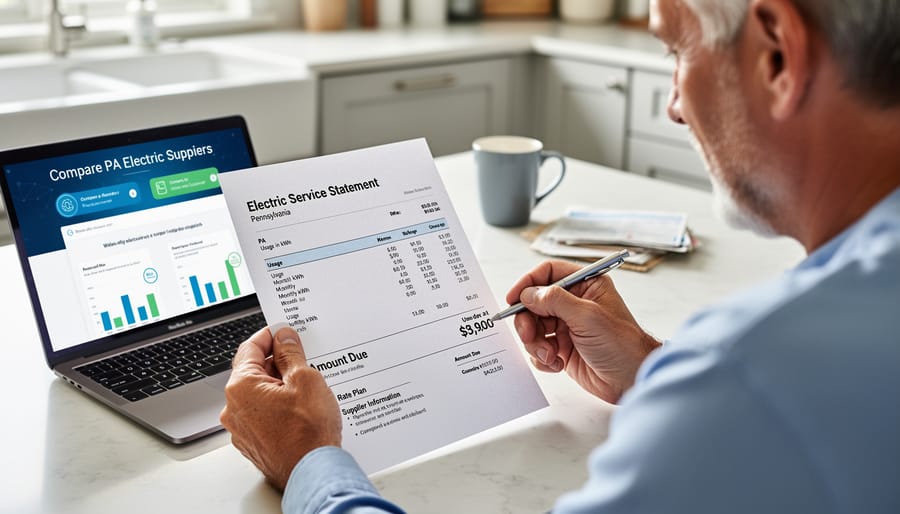
Before you start comparing electricity suppliers, take a few minutes to gather the information you’ll need. Having these details ready makes the switching process faster and ensures you can accurately compare offers against your current situation.
Essential Items to Gather:
- Your most recent electricity bill from your utility company
- Your utility account number (found on your bill)
- Your service address ZIP code
- Your average monthly electricity usage in kilowatt-hours (kWh)
- Your current Price to Compare (PTC) rate in cents per kWh
Your electricity bill is the single most important document for this process. It contains your account number, which suppliers need to initiate the switch, and your Price to Compare rate, which serves as your benchmark for evaluating competitive offers. The PTC changes multiple times per year based on market conditions, so use your latest bill to ensure you’re working with current numbers.
Understanding your usage patterns helps you choose the right plan. Look at several months of bills if possible to identify your typical consumption. Some suppliers offer better rates for higher-usage customers, while others specialize in serving smaller households. Your ZIP code determines which competitive suppliers serve your area, so you’ll enter it when searching for available options.
Don’t worry if you can’t find something right away. Your utility’s customer service can provide your account number, and your bill clearly labels the Price to Compare rate. Once you have these basics, you’re ready to start exploring your options.
Understanding Your Price to Compare (PTC)
Your Price to Compare (PTC) is the single most important number when evaluating electricity suppliers in Pennsylvania. This is your utility company’s default electricity supply rate, the rate you’re currently paying if you haven’t switched to a competitive supplier. The PTC appears on every utility bill and is measured in cents per kilowatt-hour (kWh), which makes it easy to compare directly against competitive offers.
Finding your PTC is straightforward. Look at your current electric bill for a line item labeled “Price to Compare” or “PTC.” It’s typically shown prominently, often in a box or highlighted section, specifically because Pennsylvania regulations require utilities to make this number clear for comparison shopping. The rate will appear as a dollar amount per kWh, usually expressed in cents, for example, 8.5¢ per kWh or $0.085 per kWh.
Understanding why the PTC fluctuates helps explain the value of shopping around. Your utility company purchases electricity on the wholesale market and passes those costs through to customers who haven’t chosen a competitive supplier. When wholesale prices rise or fall, influenced by factors like natural gas costs, weather patterns affecting demand, and regional grid conditions, your utility adjusts the PTC accordingly. This means the rate you pay today might be higher or lower in three months.
This benchmark is your starting point for every comparison. Any competitive supplier offer should be evaluated against your current PTC. If a supplier quotes 7.8¢ per kWh and your PTC is 8.5¢ per kWh, you’re looking at potential savings. If the offer is higher than your PTC, you need to determine whether other benefits, like renewable energy sources or rate stability, justify the premium.
Step-by-Step: How to Switch Your Electricity Supplier in Pennsylvania

Step 1: Find Available Electricity Suppliers in Your Area
The first action you’ll take is finding out which competitive electricity suppliers operate in your area. Pennsylvania has dozens of licensed suppliers, but not every company serves every ZIP code across the state. Start with the PA PowerSwitch program resources, which maintain the most comprehensive database of available suppliers by location. You can access this information through the official PA PowerSwitch website or by calling their consumer hotline for personalized assistance.
When you enter your ZIP code into supplier comparison tools, you’ll see a filtered list of companies licensed to serve your specific area. Focus initially on three key pieces of information: the supplier’s name and license status, their offered rates in cents per kWh, and whether they provide fixed or variable rate plans. Don’t worry about choosing a plan yet, this step is purely about understanding your options and building a shortlist of legitimate suppliers to evaluate further in the switching process 2026.
Make note of suppliers offering renewable energy options if clean power aligns with your goals. Write down three to five supplier names that appear to have competitive rates compared to your current Price to Compare, which you’ve already located on your utility bill. This preliminary list becomes your research foundation for the detailed comparison in the next step.
Step 2: Compare Rates and Plan Options
Once you’ve identified available suppliers, compare their offers methodically against your utility’s Price to Compare. This rate comparison determines whether switching saves you money. Look at the supplier’s cents per kWh rate first, this is your direct comparison to the PTC on your current bill. A supplier charging 8.5 cents per kWh when your PTC is 9.2 cents represents real savings; one charging 9.8 cents costs you more.
Pay close attention to plan structure. Fixed-rate plans lock in your supply rate for a set contract term, typically 6 to 36 months, protecting you from market fluctuations but committing you to that rate even if prices drop. Variable-rate plans fluctuate monthly based on market conditions, they might offer lower introductory rates but can spike unexpectedly. If budget predictability matters, fixed rates usually make more sense. If you’re willing to monitor monthly and switch as needed, variable plans offer flexibility.
Contract length affects your commitment. Longer contracts often secure lower rates but may carry early termination fees if you leave before the term ends. Review what happens when your contract expires, some suppliers auto-renew at higher rates, while others revert you to month-to-month terms.
Check whether suppliers offer renewable energy options if sustainability matters to you. Pennsylvania’s competitive market includes suppliers providing wind, solar, or other clean energy sources, though these plans may price slightly higher than conventional electricity.
Finally, scrutinize fees beyond the per-kWh rate. Monthly service charges, enrollment fees, or cancellation penalties add to your actual cost. When comparing the best energy rates calculate total monthly cost, not just the headline rate, to make an accurate comparison.
Step 3: Enter Your ZIP Code to View Available Rates
Most supplier comparison tools, including PA PowerSwitch, use your ZIP code to automatically filter which competitive suppliers can serve your specific location and what rates they’re offering. Pennsylvania’s deregulated market means availability varies by service territory, so entering your five-digit ZIP code narrows hundreds of statewide options down to the handful of suppliers licensed to operate in your area.
Once you enter your ZIP code, the comparison platform displays current rates in cents per kilowatt-hour (kWh) alongside plan details like contract length, rate type (fixed or variable), and whether renewable energy sources are included. Review these localized offers carefully, comparing each rate directly to your utility’s Price to Compare from your recent bill. The tool should show side-by-side comparisons that make it easy to spot plans offering savings or specific features like green energy that match your priorities.
Step 4: Choose a Plan and Initiate the Switch
Once you’ve compared rates and found a plan that beats your Price to Compare, it’s time to commit. Most suppliers let you enroll online, by phone, or through the PA PowerSwitch program website. You’ll typically need your utility account number (from your bill), service address, and an estimate of your monthly usage. Review the contract terms one more time, lock in the rate duration, confirm any early termination fees, and verify whether the rate is fixed or variable beyond the initial period.
After you submit your enrollment, the supplier contacts your utility to request the switch. This process follows Pennsylvania’s Chapter 57 switching process (52 Pa. Code §§ 57.171-57.180), which governs how and when supplier changes occur. The utility validates your account details, confirms you’re eligible to switch, and schedules the transition. You won’t experience any service interruption, your lights stay on, your meter keeps running, and the poles and wires don’t change hands.
Expect the switch to take effect on a future billing cycle, not immediately. The exact timing depends on when your enrollment is processed relative to your meter-read dates. Some switches complete within one billing period; others may span two. You’ll receive confirmation from your new supplier, and your next utility bill will reflect the change with the supplier’s name listed alongside the generation charges.
Don’t cancel your current supplier before the new one confirms enrollment. Pennsylvania’s procedures prevent double billing and service gaps, but jumping the gun can cause unnecessary delays or complications.
Important Safeguards and What to Watch For
Before you finalize your supplier choice, understand the consumer protections and potential pitfalls that can affect your experience. Pennsylvania regulations establish customer protections during switches under Chapter 57, Subchapter M, but you need to stay alert to avoid common issues.
Never respond to high-pressure sales tactics or sign a contract on the spot. Legitimate competitive suppliers give you time to review their offers and read the fine print. If a door-to-door salesperson or telemarketer pressures you to switch immediately, that’s a red flag. Always take contract documents home, review the terms carefully, and compare and switch at your own pace.
Pay close attention to contract length and cancellation terms. Some suppliers lock you into multi-year agreements with early termination fees ranging from $50 to several hundred dollars. Variable-rate plans may start lower than your Price to Compare but can spike unexpectedly when wholesale prices rise. Read every line of your contract before signing, noting the exact rate in cents per kWh, contract duration, renewal terms, and all potential fees.
Your utility company plays no role in supplier selection and won’t recommend specific competitive suppliers. They remain responsible for maintaining power lines, responding to outages, and delivering electricity regardless of which supplier you choose. The switch itself happens behind the scenes through administrative processes; your power won’t be interrupted, and no technician needs to visit your home. You’ll continue receiving a single bill from your utility showing both the delivery charges they collect and the supply charges your competitive supplier sets.
Verifying Your Switch and What Happens Next
Your switch becomes official when your utility bill reflects the new supplier’s name and rate. This confirmation typically appears one to two billing cycles after you’ve enrolled, though the exact timing follows procedures outlined in Chapter 57, Subchapter M (52 Pa. Code §§ 57.171-57.180). Check your next bill carefully for a section labeled “Electric Generation Supplier” or “Competitive Supply Service”, you’ll see your chosen supplier’s name instead of your utility’s default generation service.
Your utility company remains your single point of contact for billing, even with a competitive supplier. You’ll still receive one monthly bill from your utility, but it will now show two distinct charges: the supply charge from your competitive supplier and the delivery charge from your utility. The delivery portion covers poles, wires, metering, and maintenance, services that never change regardless of who supplies your electricity.
Compare the new supply rate on your bill against your previous Price to Compare to verify the savings you expected. If the numbers don’t match your contract terms, contact your supplier immediately. Your utility handles meter reading and billing calculations, but your supplier sets the generation rate you’re paying per kilowatt-hour.
Service reliability remains unchanged throughout the switch. Your utility still responds to outages, maintains infrastructure, and delivers power to your home or business. Choosing a competitive supplier is purely a financial and renewable investment decision, the physical electricity reaching your property flows through the same grid with identical reliability standards.
Real Experiences: What PA Customers Say About Switching
Sarah Mitchell, a homeowner in suburban Philadelphia, switched to a competitive supplier in early 2026 after comparing ranked 2026 rates against her utility’s Price to Compare. “I was paying 9.2 cents per kWh on my default rate. After reviewing my options, I locked in a fixed rate at 7.8 cents per kWh with a renewable energy component. The switch took about three billing cycles, and I’ve saved roughly $35 each month without any service interruption.”
Tom Rodriguez, who owns a small manufacturing business in Pittsburgh, switched primarily for cost predictability. “Variable rates were killing our budget planning. We moved to a two-year fixed contract that’s about half a cent lower per kWh than what we were paying. The process was straightforward once I gathered our account information and usage history.”
Jessica Chen switched specifically for renewable energy access. “My utility’s default supply wasn’t green. Finding a 100% wind-powered option through a competitive supplier aligned with our household values, and the rate was competitive with the standard supply.”
Frequently Asked Questions About Switching Electric Suppliers in PA
Switching electricity suppliers in Pennsylvania is straightforward once you understand the process, but most customers have similar questions before making the change. Here are clear answers to the most common concerns.
Can I switch back to my utility’s default supply?
Yes. You can return to your utility’s default electricity supply at any time, though you may face early termination fees if you’re still under contract with your competitive supplier. Once you switch back, you’ll pay the utility’s Price to Compare rate.
Will my power be shut off during the switch?
No. Your electricity service continues uninterrupted throughout the switching process because your utility company still owns and maintains all the physical infrastructure. The transition happens administratively, not physically.
What happens if I move to a new address in Pennsylvania?
Your electricity supply contract doesn’t automatically transfer to your new address. You’ll need to notify your current supplier and either sign up for service at the new location (if they serve that area) or choose a different supplier.
How often can I switch suppliers?
You can switch as often as you want, provided you’re not locked into a contract with early termination fees. Chapter 57, Subchapter M governs the switching procedures at 52 Pa. Code §§ 57.171-57.180, ensuring the process remains accessible to all Pennsylvania customers.
Service reliability remains identical whether you use a competitive supplier or your utility’s default supply. Your local utility company continues handling all power delivery, maintaining power lines and meters, and responding to outages regardless of who supplies your electricity. The physical infrastructure and emergency response don’t change.
Regarding fees, competitive suppliers set their own pricing structures. Some charge monthly fees, early termination penalties, or enrollment costs, while others offer straightforward per-kilowatt-hour rates with no additional charges. Read the contract terms carefully before signing to understand the complete cost structure, not just the advertised rate. Compare the total price per kWh (including all fees) against your utility’s Price to Compare to determine actual savings.
You’re not required to accept door-to-door sales offers or telephone pitches immediately. Pennsylvania law allows you to take your time, research suppliers independently through the PA PowerSwitch program, and make informed decisions without pressure. If a sales approach feels aggressive or unclear, it’s perfectly acceptable to decline and conduct your own comparison shopping.
Pennsylvania’s deregulated electricity market gives you genuine control over your energy choices. You’re not locked into your utility’s default supply rate, you have the legal right to choose a competitive supplier that better aligns with your budget or sustainability goals while your utility continues managing the poles, wires and infrastructure that keep your power flowing.
The switching process comes down to a few essential steps: gather your account information, find your Price to Compare on your current bill, compare available supplier rates in your area, and select a plan that makes sense for your needs. Whether you’re motivated by cost savings or renewable energy, the key is comparing apples to apples using cents per kilowatt-hour against your utility’s PTC.
Take your time reviewing contract terms, watch for early termination fees, and don’t let high-pressure sales tactics rush you into a decision. The PA PowerSwitch program exists to facilitate informed choices, not impulse switches.
At Sun Nature Power Solutions, we’re committed to helping Pennsylvania consumers make sustainable energy decisions that reflect both their values and their practical needs. Your electricity choice matters, use it wisely.