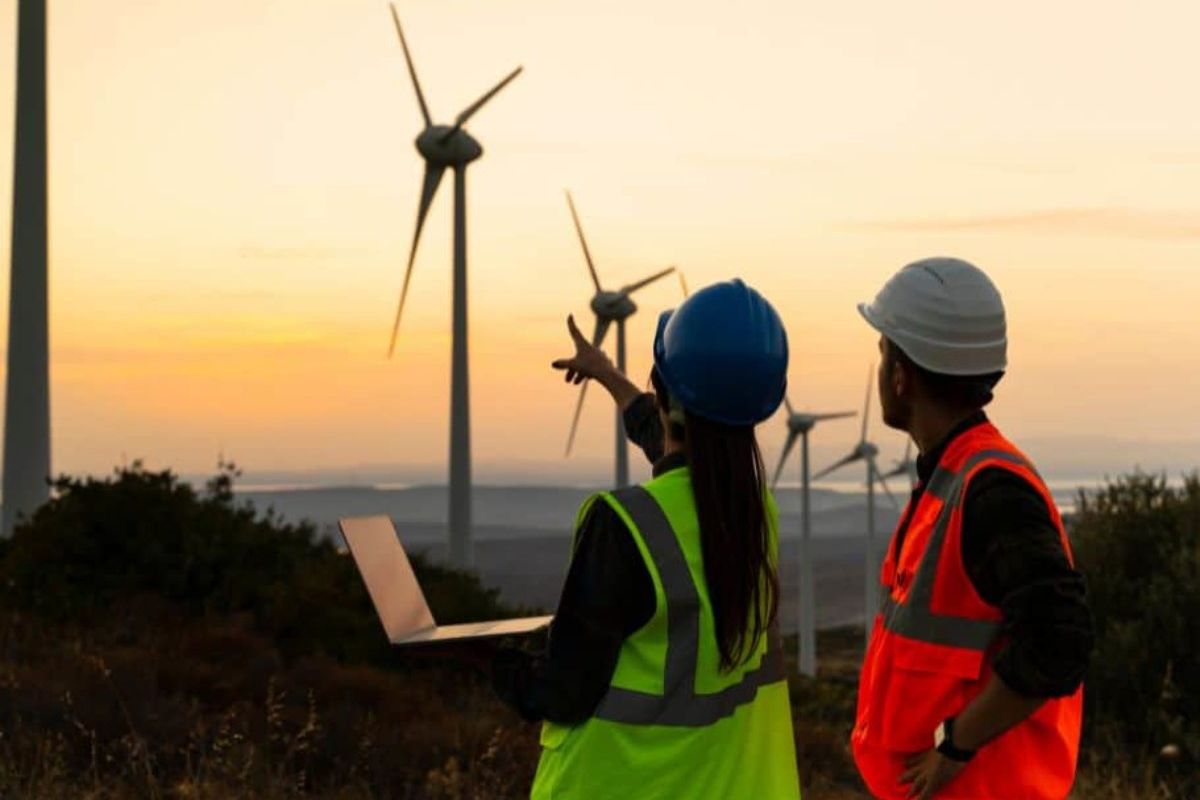
Utility Scale / Large Wind
Wind
farms are clusters of wind turbines that generate electricity. They
are located in areas with reliably favorable wind speeds. Private
companies are developing most of the wind farms in the United States. Wind farm developers use their own land or lease land from farmers,
ranchers, or in some cases from the government. The developers sell
electricity from the wind farms to power marketers, electric utilities,
and in some cases, directly to specific companies or government
agencies. There are many individuals that use one or two wind turbines
to "farm the wind" on their property.
New
York State is recognized as having about 5,000 MW of land based
wind potential, enough to generate about 13 million megawatt-hours
(MWh) or equivalent to 10 percent of the State's electricity consumption.
As a result of electric power deregulation, the demand for clean
energy is expected to rise as more consumers exercise their rights
to choose cleaner sources of electricity.
NYSERDA's, New York Energy
$martSM program through 2001, has supported the construction
and operation of 41.5 megawatts (MW) of wind energy generation in
New York. NYSERDA is currently supporting extensive wind resource
prospecting efforts to identify promising new sites for wind development.
These sites have the potential to satisfy increasing consumer demand
for green energy and various green energy purchase mandates in neighboring
states.

Learn
about NYSERDA's utility scale/large wind initiatives:
Wind
Plant Development Program
This
program supported the installation and operation of two large-scale
wind power plants in New York . These wind plants, totaling 41.5
MW are located in Madison County, NY and are paving the way for
present and future wind development in New York . Increasing the
availability of wind energy supported early-stage green marketing
efforts, improved regional air quality, and provided economic stimulus
to a growing number of communities interested in local renewable
resource development. NYSERDA is currently working with three developers
to develop four projects totaling 425 MW.
Wind
Prospecting
NYSERDA
actively supports exploration of windy sites in New York in an effort
to capture the economic development benefits associated with this
resource potential, while satisfying increased demand for clean
resources. These projects measure
the wind resources, evaluate environmental impacts of a wind farm
on the site, secure land rights for measuring the wind speed and
for ultimate wind farm development, develop site and interconnection
designs, and work with the local governments to ensure the project
is a success.
Measuring wind speed is
a critical element of site evaluation. The performance and economics
of wind energy systems are very sensitive to the magnitude and variability
of the wind resource, which is highly site specific. Sites with
average annual wind speeds of 15 to 17 mph or more are preferred.
Wind speeds must be measured for up to a year or more at several
locations on a potential wind farm. This helps developers determine
plant viability and help developers optimize plant performance by
optimally situating the individual wind turbines.
Evaluating the environmental impact of a wind plant is of critical
importance. Impacts on resident and migrating avian populations
and any endangered species are evaluated. Visual and noise impacts
are evaluated and modeled.
Working with the local governments and landowners is critical to
project acceptance and success. Developers must secure land rights
to develop the project. Agreements are negotiated where landowners
are paid in a lump sum, or through annual royalty payments based
on the amount of energy produced by the turbines installed on the
land. Developers must also work with the local governments to negotiate
payments and to ensure that the community accepts the project.
Wind Mapping and Forecasting
One of the biggest barriers
to the use of wind energy is the lack of detailed information about
the wind conditions throughout the State. Through a NYSERDA contract,
AWS TrueWind, an Albany firm has produced a detailed wind resource
atlas, characterizing the resources available for power production
in New York. The New
York Wind Resource Map is designed to facilitate the development
of wind energy both for large-scale generation (wind farms) and
for smaller, single wind turbine applications. In addition, the
Wind Map is intended for a wide variety of users, including government
planners, private energy developers, electric utilities, private
individuals and businesses, and university researchers.
In addition to knowing where the wind is, it is vital to be able
to reliably predict the output of wind power plants over several
days, the period in which plant dispatch scheduling and spot-market
purchase and sale decisions are made. Although weather forecasting
is a well-established science, techniques for wind energy forecasting
are very new. NYSERDA, through AWS
TrueWind has developed a prediction model that will put energy
marketers in a better position to sell wind power in the energy
marketplace by reducing uncertainties associated with using this
intermittent power source.
Outreach & Education for Wind Planning Projects
Global Energy Concepts
(GEC) is working with NYSERDA to identify and summarize the
experience of wind power development in New York and other states
with local planning agencies and other government authorities. GEC
will use this information to develop a wind guide for towns and
counties, and to develop and conduct a workshop to educate various
stakeholders about planning, development and implementing utility-scale
wind projects.
Questions on wind planning projects can be directed to info@nyserda.org.
The SEQR Process - Environmental Assessment Form
In New York State, development
projects that receive state funding or require approval by a local
government are subject to review under the State Environmental Quality
Review Act (SEQR). The SEQR review process typically begins when
the developer applies for a permit from a local government agency.
In most cases this local government agency will manage the SEQR
process as the "lead agency." Under certain circumstances
the SEQR lead agency may be designated by the Commissioner of the
Department of Environmental Conservation (DEC). Click
here to view the DEC's guide to the SEQR process.
Wind development projects that are designated as Type I or unlisted
actions under SEQR will be required to prepare and submit an Environmental
Assessment Form (EAF) to the lead agency. The EAF form assists government
agencies in assessing the environmental significance or non-significance
of a proposed project, in balance with social and economic factors.
Examples of completed EAF's, including attachments as outlined below,
for the completed Madison Wind Power Project and the Flat Rock Wind
Power Project (in progress), are available from NYSERDA on CD-ROM.
Interested parties may request a full copy of these EAF's free of
charge by e-mail. Please include "EAF" in the subject heading, and a postal
address in the body.
EAF Contents Include:
Environmental Assessment Form Part One (Project Information)
Environmental Assessment Form Part Two (Project Impacts and their Magnitude)
Environmental Assessment Form Part Three (Evaluation of the Importance of Impacts)
Visual EAF Addendum
Figures
Figure 1. Site Location
Figure 2. Proposed Site Plan
Figure 3. Federal Wetlands
Figure 4. State wetlands
Figure 5. Soils
Figure 6. Agriculture District Map
Attachments
Attachment A. Agency Correspondence
Attachment B. Phase I Avian Risk Assessment and Addendum
Attachment C. Agricultural Protection Measures
Attachment D. Visual Impact Assessment
Attachment E. Cultural Resources Survey
Attachment F. Noise Impact Study
|